
Walk into almost any laboratory, electronics chemical production line or pharmaceutical facility, and you’ll notice a common detail on the storage shelves: amber bottles.
They are used for photoresists, developer solutions, UV-curable materials, analytical reagents and many specialty chemicals. This isn’t simply an industry convention or a matter of appearance. Amber packaging is selected because it helps reduce one of the most common causes of chemical instability—light exposure.
However, experienced manufacturers know that bottle color is only one part of the equation. Material quality, cleanliness, sealing performance and manufacturing consistency are equally important when protecting sensitive formulations.
This article explains why amber bottles are widely used, where they perform best and what buyers should consider before selecting a container.
What Are Light-Sensitive Chemicals?
Some chemicals gradually change when exposed to ultraviolet (UV) or visible light.
Depending on the formulation, light exposure may trigger oxidation, polymerization, discoloration or changes in viscosity. Even short-term exposure during sampling or transportation can affect product consistency.
Examples include:
- Photoresists used in PCB manufacturing
- Developer solutions
- UV-curable resins
- Photo imaging chemicals
- Photoinitiators
- Certain laboratory reagents
- Diagnostic and analytical solutions
For manufacturers supplying these products worldwide, packaging becomes part of the quality control process rather than simply a shipping container.
Why Amber Bottles Instead of Clear Bottles?
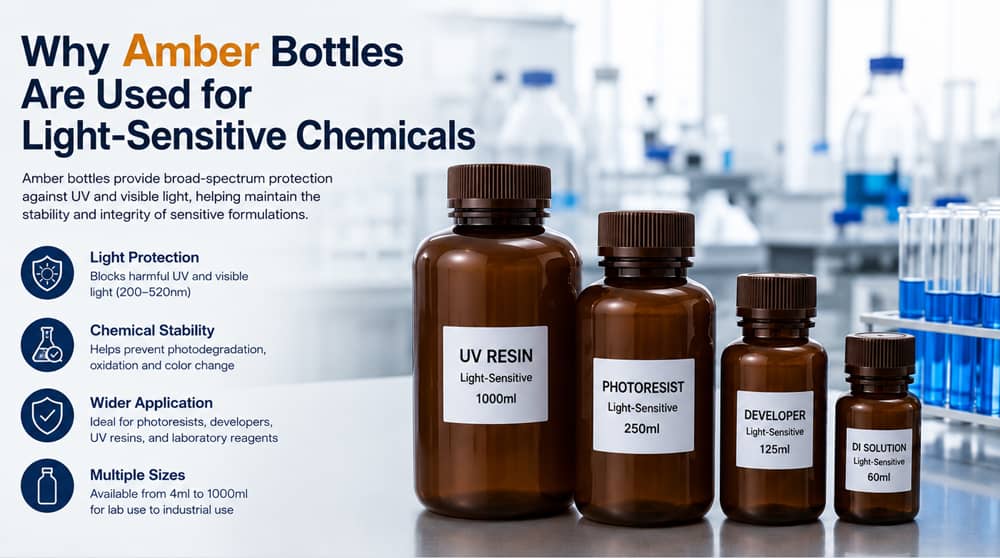
Amber bottles help reduce the amount of UV and short-wavelength visible light reaching the contents.
Although different formulations have different stability requirements, reducing unnecessary light exposure helps maintain chemical consistency during storage, transportation and routine laboratory handling.
For this reason, amber bottles have become the preferred packaging option across multiple industries, including:
- PCB manufacturing
- Electronics chemicals
- Laboratory reagents
- Biotechnology
- Pharmaceutical development
- Industrial specialty chemicals
Many companies also standardize amber bottles across different product lines, making inventory management simpler while providing an additional level of protection.
Color Alone Does Not Guarantee Chemical Safety
One misconception is that an amber bottle automatically provides suitable packaging for sensitive chemicals.
In reality, bottle performance depends on several factors working together:
Material compatibility
The bottle material should be compatible with the intended formulation.
Amber HDPE and PP bottles are commonly selected because they offer excellent resistance to many acids, alkalis, alcohols and laboratory chemicals while maintaining excellent mechanical strength.
Reliable sealing
Long-distance transportation places considerable stress on packaging.
A linerless inner cone sealing design provides direct plastic-to-plastic sealing, helping reduce leakage risks while eliminating potential contamination associated with traditional foam liners.
Manufacturing consistency
High-value chemicals deserve high-quality packaging.
Consistency in molding, dimensional accuracy and cleanliness directly influences packaging reliability during storage and transportation.
Why Packaging Cleanliness Matters
For laboratories and chemical manufacturers, contamination often begins long before a chemical is filled into a bottle.
Trace extractables, biological contamination or manufacturing residues can interfere with analytical testing, product qualification or long-term stability studies.
For this reason, packaging quality is increasingly evaluated using standardized verification procedures rather than appearance alone.
Our packaging quality program includes verification such as:
- Material compatibility evaluation
- Pharmaceutical packaging extractables testing
- Absorbance testing for liquid pharmaceutical packaging materials
- Bacterial endotoxin (pyrogen) testing
- DNase/RNase-free verification for laboratory sample containers
- Sterility testing for reagent bottles
These evaluations support packaging consistency and help reduce potential risks associated with extractables, microbial contamination and laboratory interference.
While end users should always perform compatibility testing with their own formulations, verified packaging quality provides a stronger foundation for storing sensitive chemicals.
Typical Applications for Amber HDPE and PP Bottles
Amber HDPE and PP bottles are widely used across laboratory and industrial environments.
Typical applications include:
Photoresist Storage
Protecting light-sensitive photoresists during sampling, transportation and production.
Developer Solution Packaging
Suitable for customer sampling, pilot production and laboratory storage.
UV Resin Storage
Helping reduce unnecessary light exposure during warehousing and logistics.
Electronics Chemicals
Packaging process chemicals used in PCB manufacturing and electronic component production.
Laboratory Reagents
General-purpose storage for analytical and research laboratories.
Available capacities from 4 ml to 1000 ml allow the same packaging platform to be used from R&D through commercial production.
Choosing Between HDPE and PP
Both materials are widely accepted in laboratory and chemical packaging.
HDPE is often selected when impact resistance, transportation durability and cost efficiency are priorities.
PP offers higher rigidity and better heat resistance, making it suitable for laboratory environments that require higher temperature performance.
Selecting the right material depends on the chemical formulation, storage conditions and operational requirements rather than material preference alone.
Choosing the Right Amber Bottle
Before selecting an amber bottle, buyers should consider:
- Is the bottle material compatible with the formulation?
- Does the sealing system minimize leakage risks?
- Has the packaging been manufactured under consistent quality control?
- Is there supporting verification for cleanliness and packaging quality?
- Can the same bottle family cover laboratory, sampling and commercial production?
These questions often have a greater impact on long-term product performance than bottle color alone.
Amber bottles remain one of the most effective packaging solutions for protecting light-sensitive chemicals, but true packaging reliability comes from more than light protection.
Material selection, sealing performance, manufacturing quality and verified cleanliness all contribute to protecting valuable formulations throughout storage and transportation.
For companies handling photoresists, developer solutions, UV resins and specialty laboratory chemicals, choosing a well-designed amber bottle is an investment in product consistency, customer confidence and long-term quality assurance.
Quick Selection Guide: Available Capacities
Need to scale from R&D to commercial production? Explore our standard sizes:
| Capacity | Amber HDPE | Amber PP |
| 30ml | Shop 30ml HDPE | Shop 30ml PP |
| 60ml | Shop 60ml HDPE | Shop 60ml PP |
| 125ml | Shop 125ml HDPE | Shop 125ml PP |
| 250ml | Shop 250ml HDPE | Shop 250ml PP |
| 500ml | Shop 500ml HDPE | Shop 500ml PP |
| 1000ml | Shop 1000ml HDPE | Shop 1000ml PP |
Related Insights: Deep Dives
Choosing the Right Bottle for PCB Photoresist Storage – Critical factors for semiconductor-grade storage.
Best Bottles for Developer Solution Storage and Transport – Essential tips for preventing leakage and contamination.