
Reliable Chemical Storage Containers for Laboratory and Industrial Applications
Safe chemical storage begins with the right packaging. Plastibottles manufactures HDPE reagent bottles, PP bottles and amber chemical containers designed for laboratory chemicals, industrial reagents, environmental samples and specialty formulations. Our containers combine dependable sealing, excellent chemical resistance and flexible OEM manufacturing to support laboratories and chemical manufacturers worldwide.
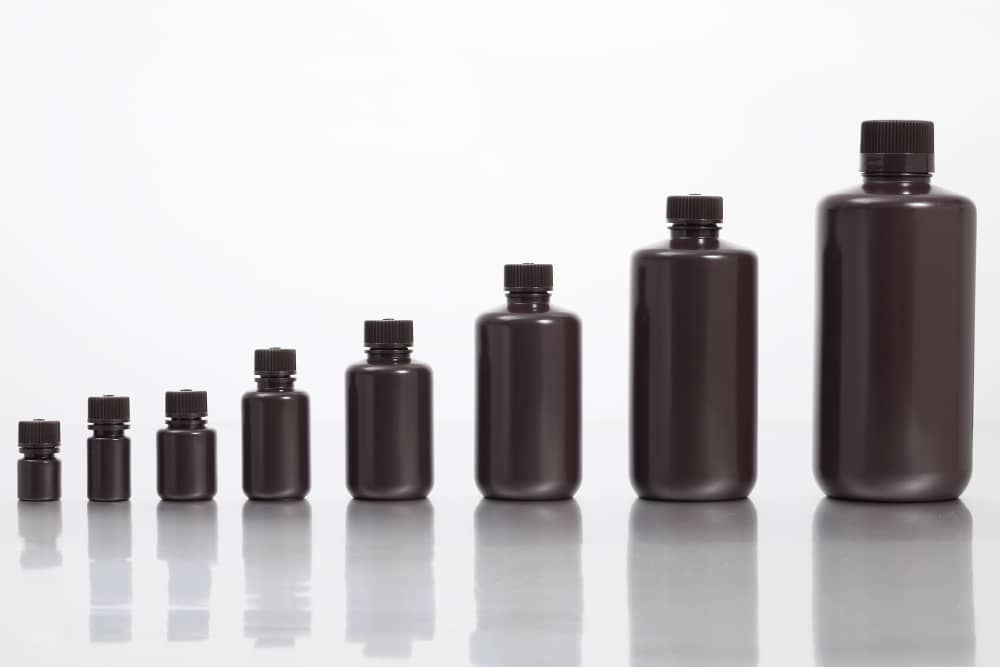
Chemical Storage Starts with the Right Container
Chemical storage is more than simply filling a bottle. The choice of container directly influences product stability, laboratory safety, transportation reliability and regulatory compliance.
Whether handling laboratory reagents, industrial process chemicals, environmental samples or specialty electronic chemicals, selecting the appropriate bottle material helps minimize contamination, reduce leakage risks and preserve the integrity of stored materials.
Modern laboratories and manufacturing facilities demand packaging that not only protects chemicals during storage but also supports efficient handling, transportation and traceability throughout the supply chain.
Plastibottles manufactures plastic chemical storage containers designed to meet these practical requirements. Our product portfolio includes HDPE reagent bottles, PP reagent bottles, amber bottles and microcentrifuge tubes that support both laboratory-scale research and industrial chemical applications.
Available in multiple capacities from 30ml to 1000ml, our containers help customers standardize chemical packaging across a wide range of storage and testing scenarios.
Why Chemical Storage Matters
Improper chemical packaging can lead to leakage, contamination, product degradation and unnecessary operational risks. Selecting suitable chemical storage containers helps laboratories and manufacturers protect valuable materials while improving handling efficiency.
Chemical Compatibility
Different chemicals interact differently with packaging materials. Selecting HDPE or PP according to the stored chemical helps reduce compatibility issues and supports long-term storage stability.
* For aggressive chemicals or specialty formulations, compatibility should always be evaluated before storage.
Leak-Proof Transportation
Chemical containers frequently move between production facilities, warehouses and laboratories. Reliable screw-cap sealing helps minimize leakage during transportation and protects both personnel and stored materials.
Consistent sealing performance also reduces the risk of sample loss during field collection or quality control testing.
Storage Stability
Many laboratory reagents and industrial chemicals require stable storage conditions over extended periods. Appropriate bottle materials help maintain product quality by providing dependable resistance to moisture, impact and routine handling.
For light-sensitive formulations, amber bottles provide an additional layer of protection by reducing UV exposure.
Operational Efficiency
Modern chemical laboratories require packaging that is easy to fill, easy to label and simple to organize. Standardized bottle sizes, durable materials and clear labeling areas simplify inventory management while improving laboratory workflows.
Common Challenges in Chemical Storage
Chemical manufacturers and laboratories often face a range of storage and packaging challenges. Selecting the appropriate container helps address these issues while improving operational safety and product reliability.
Material Compatibility
One of the most important considerations in chemical storage is compatibility between the stored chemical and the packaging material. HDPE and PP are widely used because they offer excellent resistance to many laboratory reagents and industrial chemicals. However, no single material is suitable for every formulation.
Choosing the correct bottle should always consider the chemical composition, storage duration and operating environment.
Preventing Leakage During Transportation
Chemicals are frequently transported between production plants, quality control laboratories and customer facilities. Containers with dependable sealing performance reduce the risk of leakage, helping protect personnel, equipment and valuable products throughout transportation.
Protecting Light-Sensitive Chemicals
Certain chemicals degrade when exposed to ultraviolet light. Amber HDPE bottles are commonly used to reduce light exposure and are suitable for storing photoresists, developers, analytical standards and other light-sensitive laboratory chemicals.
This makes amber bottles particularly valuable in semiconductor manufacturing, electronics laboratories and specialty chemical production.
Product Identification and Traceability
Efficient chemical management depends on accurate product identification. Chemical containers should provide sufficient space for labels, batch information, barcodes and handling instructions.
For OEM customers, customized labeling and private branding support consistent product identification throughout distribution and laboratory use.
Supporting Regulatory Compliance
Many organizations require packaging documentation as part of supplier qualification and internal quality systems. Providing technical specifications, material information and supporting documentation helps simplify purchasing decisions while supporting laboratory quality management procedures.
Industries We Support
Our chemical storage containers are used across a broad range of industries where safe chemical handling, reliable packaging and dependable storage are essential.
Chemical Manufacturing
Storage of laboratory reagents, production samples and quality control chemicals.
Environmental Testing
Collection and storage of water, soil and environmental monitoring samples.
Petroleum & Energy
Packaging solutions for fuel testing, lubricants, additives and analytical laboratory workflows.
Water Treatment
Storage of treatment chemicals, testing reagents and sampling solutions.
Agricultural Laboratories
Containers for fertilizer analysis, pesticide testing and agricultural research.
Semiconductor
Amber reagent bottles designed for storing photoresists, developers and light-sensitive electronic chemicals.
Looking for Reliable Chemical Storage Containers?
Whether you need HDPE reagent bottles for routine laboratory use, PP bottles for specialized applications or amber bottles for light-sensitive chemicals, Plastibottles provides dependable packaging solutions backed by consistent manufacturing and responsive technical support.
Packaging Solutions for Diverse Chemical Storage Needs
Chemical storage requirements vary significantly depending on the type of chemical, storage duration and operating environment. Plastibottles provides HDPE reagent bottles, PP bottles and amber containers designed to support a wide range of laboratory and industrial applications.
Laboratory Reagent Storage
Research laboratories, universities and quality control departments require reliable containers for daily reagent preparation and storage. HDPE reagent bottles are widely used for storing aqueous solutions, buffer solutions, diluted acids and alkaline reagents due to their excellent chemical resistance and impact strength.
Narrow-mouth bottles are preferred for liquids because they improve dispensing accuracy and reduce spills, while wide-mouth bottles simplify the handling of powders and solid chemicals.
Industrial Chemical Storage
Chemical manufacturers and industrial facilities require packaging that supports internal handling, warehouse storage and transportation. Our HDPE and PP bottles are suitable for many routine industrial chemicals, production samples and quality control materials. Multiple bottle capacities allow manufacturers to standardize packaging across different production processes.
Typical applications include:
- Quality control samples
- Production intermediates
- Laboratory reference solutions
- Process chemicals
Environmental & Water Testing
Environmental monitoring organizations rely on secure containers to transport water and soil samples from the field to the laboratory. Leak-proof screw-cap bottles help maintain sample integrity during transportation while minimizing contamination risks. Available in capacities from 250 ml to 1000 ml, our bottles support a variety of environmental testing programs.
Typical uses include:
- Drinking water testing
- Surface water monitoring
- Wastewater analysis
- Soil extract storage
Petroleum & Energy Laboratories
Petroleum laboratories perform routine testing of fuels, lubricants and additives. Sample containers should provide dependable sealing, stable dimensions and compatibility with common laboratory testing procedures. HDPE and PP bottles are widely used for collecting, transporting and storing analytical samples before testing.
Typical applications include:
- Fuel sampling
- Lubricant testing
- Additive analysis
- Quality assurance
Electronic & Specialty Chemicals
Electronic chemicals often require higher packaging standards due to their sensitivity to contamination and light exposure. Amber HDPE bottles are commonly selected for storing photoresists, developers and specialty formulations that require protection from ultraviolet light.
Consistent bottle dimensions and dependable sealing support stable storage and transportation throughout the semiconductor supply chain.
Recommended Chemical Storage Products
Different storage tasks require different bottle designs. Choosing the right material, neck style and capacity helps improve handling efficiency while protecting valuable chemicals. Our containers combine dependable sealing, excellent chemical resistance and flexible OEM manufacturing to support laboratories and chemical manufacturers worldwide.
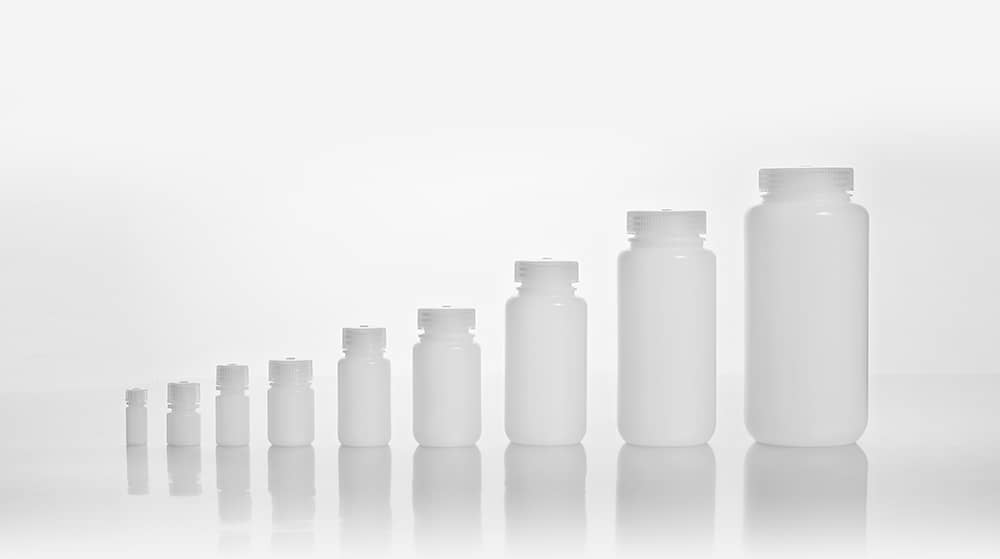
HDPE Chemical Storage Bottles
HDPE bottles are one of the most commonly used solutions for laboratory reagents and industrial chemicals.
Advantages
- Excellent resistance to many acids and alkalis
- Lightweight yet durable
- Reliable leak-proof screw cap
- Routine laboratory and industrial use
- Multiple capacities available
Typical Applications
- Chemical reagent storage
- Environmental testing
- Water sampling
- Industrial laboratories
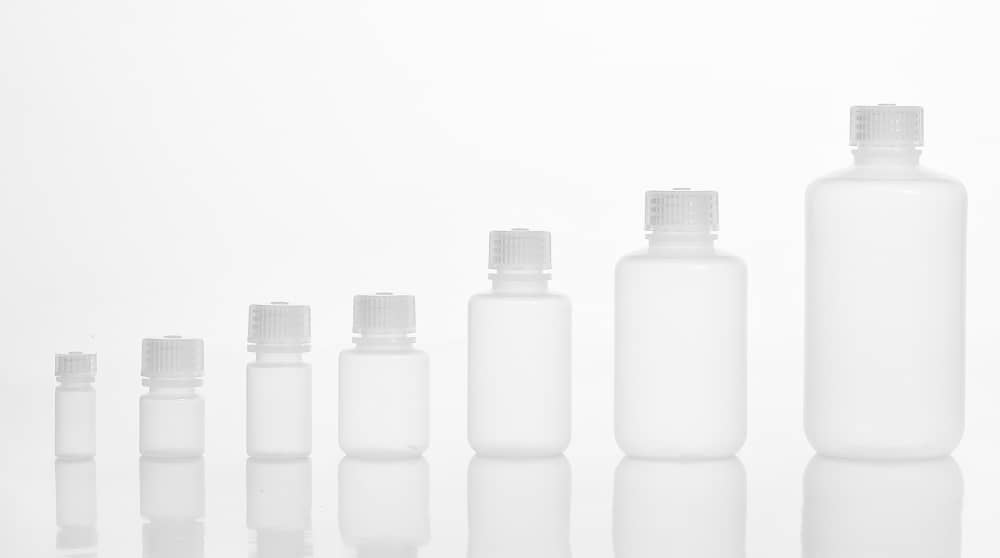
PP Chemical Bottles
PP bottles provide higher heat resistance and are suitable for laboratories requiring elevated temperature performance or repeated cleaning.
Advantages
- Higher temperature tolerance
- Good rigidity
- Stable dimensions
- Pharmaceutical and analytical laboratories
Typical Applications
- Pharmaceutical laboratories
- Quality control
- Biological laboratories
- Chemical analysis
Bottles →
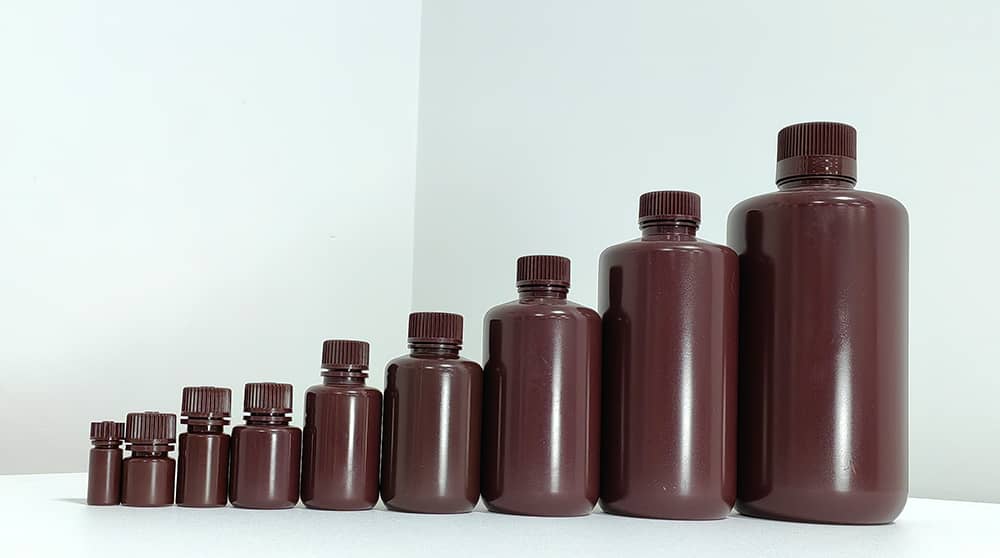
Amber Chemical Bottles
Amber bottles help protect photosensitive chemicals from ultraviolet light.
Advantages
- UV protection
- Suitable for photoresists and developers
- Dependable sealing
- Multiple sizes available
Typical Applications
- Semiconductor manufacturing
- Electronic chemicals
- Analytical standards
- Light-sensitive reagents
HDPE vs PP for Chemical Storage
Selecting the correct material is essential for safe and effective chemical storage. HDPE and PP each offer unique advantages depending on the application.
| Property | HDPE | PP |
|---|---|---|
| Chemical Resistance | Excellent for many acids, alkalis and aqueous solutions | Excellent for a wide range of laboratory reagents |
| Impact Resistance | Excellent | Good |
| Temperature Resistance | Good | Higher |
| Weight | Lightweight | Lightweight |
| Routine Chemical Storage | ✓ | ✓ |
| Environmental Sampling | ✓ | ✓ |
| Pharmaceutical Testing | ✓ | ✓ |
| Laboratory Applications | ✓ | ✓ |
Choosing the Right Chemical Bottle
Selecting the correct bottle involves more than choosing a size. The following factors should be evaluated before purchasing.
Chemical Type
Consider the compatibility of the stored chemical with the bottle material.
Storage Duration
Long-term storage may require additional evaluation of compatibility.
Light Sensitivity
Use amber bottles for chemicals requiring UV exposure protection.
Transportation
Durable materials and leak-proof closures protect chemicals during shipping.
Capacity
Choose a size that minimizes headspace while supporting laboratory operations.
Quick Capacity Reference
| Capacity | Typical Applications |
|---|---|
| 30 ml | Standards, small-volume reagents |
| 60 ml | Laboratory solutions |
| 125 ml | Routine reagent storage |
| 250 ml | Sample collection |
| 500 ml | Chemical storage |
| 1000 ml | Bulk laboratory reagents |
Chemical Storage Workflow
Proper chemical storage involves a series of controlled steps designed to maintain product quality and ensure laboratory safety. Each stage requires appropriate packaging to reduce contamination risks, improve traceability and protect valuable chemicals throughout their lifecycle.
Chemical Preparation
Material Selection
(HDPE / PP / Amber)
Bottle Filling
Leak-Proof Cap Assembly
Labeling & Batch ID
Transportation
Warehouse Storage
Laboratory Use
Need Help Selecting the Right Chemical Storage Bottle?
Whether you are storing laboratory reagents, industrial chemicals or light-sensitive electronic formulations, our technical team can recommend the most suitable bottle material, size and configuration for your application.
Quality Assurance for Chemical Storage Containers
Reliable chemical storage begins with reliable packaging. At Plastibottles, quality is built into every stage of manufacturing—from raw material selection to inspection and packaging. We prioritize product consistency, traceability and long-term supply reliability over production volume alone.
High-Quality Materials
Manufactured using carefully selected HDPE and PP resins known for durability, chemical resistance, and dimensional stability.
Amber bottles reduce UV exposure for light-sensitive electronic formulations.
Precision Manufacturing
Engineered dimensions essential for automated filling systems. Our focus includes:
- Uniform wall thickness
- Consistent thread dimensions
- Smooth bottle neck finish
- Stable capacity
Leak-Proof Performance
Screw-cap bottle designs engineered to prevent leakage, contamination, and product loss.
Proper cap fit and thread design contribute to secure shipping between facilities.
Batch Consistency
Production control procedures maintain uniform dimensions, material quality, appearance, and packaging specifications.
Simplifies procurement and reduces qualification work for repeat orders.
Verified Technical Documentation
Many laboratories and chemical manufacturers require technical documentation before approving a packaging supplier. To support qualification and procurement processes, Plastibottles can provide a range of technical documents for selected products.
Packaging Compatibility Report
Evaluates the interaction between packaging materials and stored formulations under defined conditions.
Ideal for packaging validation or long-term storage evaluations.
Extractables & Leachables Report
Supports risk assessment for sensitive formulations, evaluating potential interactions between container and product.
Sterility Test Report
Available for products requiring controlled cleanliness or verified sterility in laboratory environments.
Material Specifications
Technical information covering material type, physical properties, and manufacturing specifications.
- Material type
- Physical properties
- Manufacturing specifications
- Product dimensions
Technical Drawings
Available for selected bottle models to assist with qualification, automation planning, and OEM projects.
Product Data Sheets
Comprehensive summaries of specifications, capacities, materials, and closure options.
OEM & Private Label Manufacturing
Beyond standard products, Plastibottles supports distributors, laboratory brands and industrial suppliers through flexible OEM and private-label manufacturing services. Our engineering team works closely with customers to develop packaging solutions that align with their branding and operational requirements.
Bottle Colors
- Natural
- White
- Amber
- Custom colors (subject to MOQ)
Cap Options
- White
- Black
- Red
- Blue
- Customized colors
Branding Services
- Silk-screen printing
- Adhesive labels
- Barcode labels
- Product identification
- Batch coding
Packaging Customization
- Individual packaging
- Bulk packaging
- Export cartons
- Customized carton printing
- Retail-ready packaging
Industry Experience
Although our products are laboratory plastic containers, they are used across a diverse range of industries. Our experience includes supporting customers involved in:
Chemical Manufacturing
Packaging for laboratory reagents, production samples and quality control materials.
Environmental Testing
Containers for water sampling, environmental monitoring and analytical laboratories.
Petroleum Laboratories
Storage and transportation of fuel samples, lubricants and laboratory testing solutions.
Agricultural Testing
Packaging for fertilizer analysis, pesticide evaluation and agricultural research.
Pharmaceutical Research
Laboratory bottles supporting analytical testing, formulation development and quality control.
Semiconductor
Amber bottles used for storing photoresists, developers and other light-sensitive electronic chemicals.
Case Studies
Case Study 1 — Specialty Chemical Manufacturer
A specialty chemical producer required durable HDPE reagent bottles for storing analytical reagents used during in-process quality control.
The project required:
- Stable bottle dimensions
- Reliable leak-proof sealing
- Multiple bottle capacities
- Consistent long-term supply
Our HDPE reagent bottles were selected to support daily laboratory operations while simplifying inventory management.
Case Study 2 — Petroleum Testing Laboratory
A petroleum testing laboratory required bottles suitable for transporting fuel and lubricant samples between field locations and analytical laboratories.
The selected PP bottles provided:
- Secure screw-cap sealing
- Stable dimensions
- Lightweight handling
- Multiple bottle sizes for different testing procedures
Case Study 3 — Semiconductor Materials Supplier
A supplier of semiconductor materials required amber HDPE bottles for storing photoresists and other light-sensitive electronic chemicals.
Project priorities included:
- UV protection
- Consistent bottle dimensions
- Reliable sealing
- Clean appearance suitable for high-value materials
Amber reagent bottles were adopted to support transportation and storage while reducing light exposure.
Technical Resources
Selecting the correct chemical storage container often requires additional technical guidance. To support engineers, laboratory managers and procurement professionals, Plastibottles provides practical technical resources covering material selection, bottle sizing and chemical compatibility.
Chemical Compatibility Guide
Comprehensive chemical resistance ratings for HDPE and PP containers across various chemical formulations.
Download GuideHDPE vs PP Material Guide
A comparison sheet highlighting differences in temperature limits, flexibility, clarity, and physical impact resistance.
Download GuideReagent Bottle Selection Guide
A structured workflow helping you select between narrow-mouth and wide-mouth styles, and translucent or amber finishes.
Download GuideBottle Capacity Guide
Quick reference tables summarizing volume markings, brim-full capacities, and physical dimensions of standard series.
Download GuideTechnical Data Sheets
Detailed mechanical specifications, thread layouts, wall thickness maps, and weight limits of specific collections.
Access SheetsProduct Catalog
Browse our complete product catalog offline, featuring our entire range of leak-proof storage configurations.
Download CatalogThese resources help customers evaluate packaging options more efficiently and simplify purchasing decisions.
Need Technical Documentation for Your Chemical Storage Project?
Our team can provide product specifications, technical drawings and supporting documentation to assist your supplier qualification and packaging evaluation process.
Frequently Asked Questions
Frequently Asked Questions About Chemical Storage Containers
Chemical storage containers are designed to safely store, transport and dispense laboratory reagents, industrial chemicals, environmental samples and specialty formulations. The correct container helps maintain chemical stability, reduce contamination risks and improve workplace safety.
Both HDPE and PP are widely used for chemical storage, but the most suitable material depends on the specific chemical, storage temperature and application.
- HDPE is commonly selected for many acids, alkalis and aqueous solutions because of its excellent chemical resistance and impact strength.
- PP offers higher temperature resistance and is often preferred for applications requiring elevated operating temperatures.
Always verify compatibility with the specific chemical before long-term storage.
HDPE bottles are suitable for many diluted acids and common laboratory reagents. However, compatibility depends on the acid type, concentration, storage duration and temperature.
For aggressive chemicals, consult the Chemical Compatibility Guide or contact our technical team before selecting a bottle.
Yes.
Amber HDPE bottles help reduce ultraviolet light exposure and are commonly used for storing photoresists, developers, analytical standards and other light-sensitive formulations.
Yes.
Our bottles are designed with leak-resistant screw-cap closures to support routine transportation between manufacturing facilities, laboratories and sampling locations. Proper cap tightening and suitable packaging should always be used during shipping.
Yes. We support OEM manufacturing including:
- Custom bottle colors
- Custom cap colors
- Silk-screen printing
- Product labels
- Carton printing
- Private branding
Our products are supplied to customers in:
- Chemical Manufacturing
- Environmental Testing
- Petroleum Laboratories
- Water Treatment
- Agricultural Testing
- Pharmaceutical Research
- Semiconductor Manufacturing
- Universities and Research Institutes
For selected products, we can provide:
- Packaging Compatibility Reports
- Extractables & Leachables Reports
- Material Specifications
- Technical Data Sheets
- Technical Drawings
- Sterility Test Reports (where applicable)
Please contact our team for document availability.
Bottle size depends on:
- Sample volume
- Storage duration
- Transportation requirements
- Laboratory workflow
- Available storage space
Our standard range includes 30 ml, 60 ml, 125 ml, 250 ml, 500 ml and 1000 ml bottles.
We assist customers by providing:
- Material recommendations
- Bottle selection guidance
- OEM manufacturing
- Technical documentation
- Long-term supply support
- Responsive engineering assistance
Explore Related Chemical Storage Applications
Different chemicals require different storage solutions. Explore our application pages to learn more about packaging recommendations for specific industries and workflows.
Chemical Storage
Packaging solutions for laboratory reagents, industrial chemicals and quality control samples.
ExploreWater Sampling
Leak-proof bottles designed for environmental sampling and laboratory testing.
ExplorePetroleum Sampling
Packaging solutions for fuel, lubricant and petrochemical laboratory analysis.
ExploreEnvironmental Monitoring
Reliable containers for environmental laboratories and field sampling programs.
ExploreElectronic Chemicals
Packaging solutions for specialty electronic chemicals and semiconductor manufacturing.
ExplorePhotoresist Storage
Amber bottles designed to reduce UV exposure for photoresists and other photosensitive materials.
ExploreRelated Product Categories
Browse our full range of chemical storage containers and laboratory packaging solutions.
HDPE Reagent Bottles
Chemical-resistant bottles for laboratory reagents and industrial applications.
View ProductsPP Reagent Bottles
Laboratory bottles suitable for analytical testing and pharmaceutical environments.
View ProductsAmber Reagent Bottles
Designed for light-sensitive chemicals, photoresists and specialty formulations.
View ProductsWide Mouth Reagent Bottles
Easy filling and dispensing for powders, granules and viscous materials.
View ProductsNarrow Mouth Reagent Bottles
Ideal for liquid chemicals requiring controlled pouring and reduced spillage.
View ProductsDownload Technical Resources
Selecting the right chemical storage container is easier with the proper technical information. Visit our Resource Center to access:
Chemical Compatibility Guide
Detailed chemical resistance ratings for raw polymers against aggressive acids, alkalis, and solvents.
Download Guide →HDPE vs PP Guide
A comparison layout of material characteristics, thermal boundaries, and impact behaviors of rigid containers.
Download Guide →Reagent Bottle Selection Guide
Step-by-step guidance on selecting mouth diameter, color options, and volume targets for specific workflows.
Download Guide →Bottle Capacity Guide
Dimension schematics and volumetric data mapping actual brim-full versus nominal limits across sizing runs.
Download Guide →Product Catalog
Our fully compiled product list detailing available neck systems, dimensions, and colorway codes for ordering.
Download Catalog →Technical Data Sheets
Detailed blueprints, component tolerances, resin physical properties, and weight charts for validation files.
Access Sheets →Certificates & Documentation
Leak-proof test certifications, raw material quality reports, and compliance statements for system qualifications.
View Documents →Why Choose Plastibottles?
Choosing a packaging supplier is about more than purchasing bottles. It is about finding a reliable manufacturing partner that understands laboratory workflows, industrial chemical storage and long-term supply requirements.
Plastibottles combines manufacturing experience with application-focused technical support to help customers select appropriate packaging solutions for a wide range of laboratory and industrial chemicals.
Comprehensive HDPE and PP bottle portfolio
Amber bottles for light-sensitive formulations
OEM and private-label manufacturing
Technical documentation for selected products
Flexible production capacity
Global B2B supply experience
Responsive engineering support
Whether your application involves laboratory reagents, industrial chemicals, environmental monitoring or semiconductor materials, we are committed to providing dependable packaging solutions that support safety, consistency and operational efficiency.